Twinkle, Twinkle, Too Loud: Taking Your Dog to the Harbor's Holiday Boat Parade Without Ruining Everyone's Night
Photo: Eric Polk, CC BY-SA 4.0, via Wikimedia Commons
Dana Point Harbor in December is a postcard: docks strung with lights, boats wearing wreaths like scarves, cocoa steam drifting off the boardwalk. On boat parade night, half the dogs in town come out to admire it.
That's the part worth slowing down for. A parade is a lovely thing to watch and a complicated thing to smell, hear, and stand inside of. You get the postcard. Your dog gets a wall of legs, three competing sound systems, a horn salute, and forty minutes of standing on cold pavement while strangers reach toward his head. Whether that adds up to a great night or a rough one has almost nothing to do with how much your dog loves you and almost everything to do with planning.
Your dog is running different numbers than you are
You're tracking pretty lights and a festive mood. Your dog is tracking crowd density, boots at nose level, intermittent blasts, dropped kettle corn, and a leash that keeps going tight. One or two of those at a time is manageable for a steady, social dog. All of them together is a stress pile-up, and stress piles up faster in the cold.
The same evening that makes a bouncy young Lab's entire month can flatten a sensitive herding mix. Neither reaction is a training failure. It's temperament meeting environment.
The three-question test before you leash up
Stand at your front door and be honest:
- Has my dog recovered well from the last busy place we went? If the answer involves two days of clingy behavior or a skipped meal, that's a no.
- Can my dog take a treat and swallow it in a crowd of strangers? A dog who takes food politely is a dog with enough bandwidth left over to cope.
- Do I have a second adult with me? Two people means one can watch the dog and one can navigate. Solo handling in a dense crowd is where things go sideways.
Three yeses, and you're in good shape. Two nos, and a quiet walk on a side street with a view of the water from a distance is the kinder version of the same night.
Where to stand, and where not to
The single biggest safety upgrade you can make is choosing a spot with an exit behind you.
- Good: the upper lawn at Lantern Bay Park, where there's grass underfoot, real distance from the speakers, and a straight shot to your car.
- Good: the wider walkways on the island side of the harbor, where you can keep moving instead of being wedged in place.
- Manageable with care: the grassy strip near Baby Beach, if you arrive early and stake out space at the back.
- Skip it: the channel bridge and the narrow dockside walkways. Both funnel a crowd into a space with no lateral escape, which is exactly where a nervous dog starts feeling trapped.
Get there before dusk, park nose-out, and know your exit in the dark before the sun drops. Leaving ten minutes before the finale costs you a finale and saves you a thirty-minute shuffle through a crowd with a tired dog.
Cold, damp, and the long stand
Harbor evenings in December are a wet cold, the kind that soaks through a short coat in twenty minutes. A dog standing still on concrete loses body heat fast — much faster than one trotting along a trail.
Bring a towel, a mat or blanket to stand on, and a coat for thin-coated or older dogs. Skip the handouts. Parade food is a hazard list in a paper tray: chocolate, macadamia nuts, grapes, onion-dipped things, and ham bones that splinter. A dropped glow stick is worse — the liquid inside is bitter and irritating, and the plastic is a chew toy with a secret.
Decoration hazards worth noticing
Holiday displays mean extension cords snaking across walkways, light strings at paw height, battery packs, tinsel, and the little faux-snow piles that look exactly like something to eat. Keep your dog on a short leash in decorated areas, and don't let him investigate the base of any display. Lit cords get hot, and a startled dog who yanks free near one can take a shock or a burn.
Horns, music, and the sound stack
Boat horns are the one part of the parade you can't predict. A dog who startles hard at a car backfire will startle harder at a chorus of horns across open water, because sound carries and comes from everywhere at once.
Position yourself as far from the water's edge and the speakers as the view allows. If you can hold a normal conversation without raising your voice, you're in a workable spot for most dogs.
Reading the exit signs
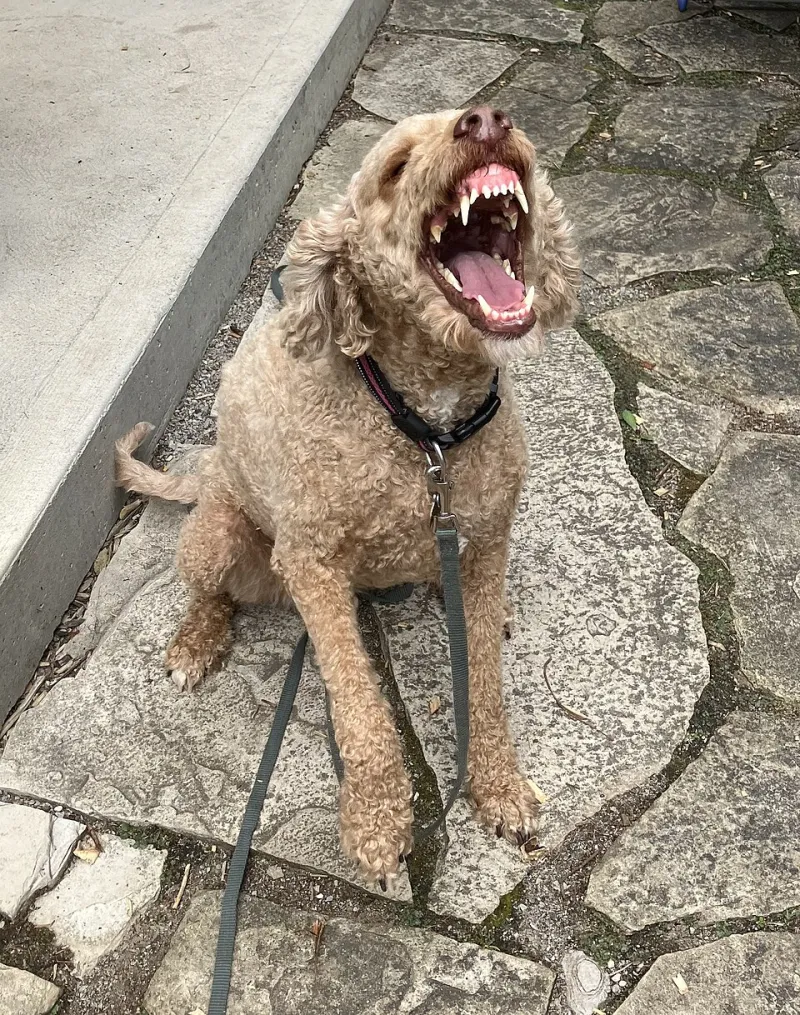
Dogs tell you before they fall apart. Watch for yawning out of context, repeated lip licking, a tongue flick that isn't about food, whale eye (the whites showing as he turns his head away), a tucked tail, freezing in place, refusing treats he'd normally inhale, or sudden intense grooming of a front leg.
One of those is a nudge. Three at once is a decision — you're leaving. And if he's already shut down, don't wait for a fourth sign to prove your point.
What about the cat?
Cats stay home. A parade is not a cat activity, and even a confident harness-trained cat is being asked to tolerate a crowd of unpredictable feet. What your cat needs from parade night is a quiet interior room, a closed door between her and the front entry, and someone coming home at a reasonable hour.
The morning-after check
Before you collapse, run your hands over paws and between toes for glass, gum, and salt grit, dry the ears and the underside of the coat, and give the coat a quick rinse if it's stiff with salt spray. Then watch the next day for limping, GI upset, or unusual crankiness — all of which are easier to sort out when you call early.
Enjoy the lights. Just decide in advance which version of the evening your dog is actually signing up for.