Pile Drivers and Paw Prints: Helping Dana Point Pets Cope With Construction Season
Living near a working harbor means living near work. Over the past several years, Dana Point's waterfront has been a rotating cast of fencing, heavy equipment, demolition, and hauling — and for a dog whose whole world is a four-block radius of scent, that adds up to something bigger than an inconvenience.
Construction is not just loud. It rearranges the map. Familiar landmarks disappear behind plywood, the smell of the street changes, and the route your dog has walked since puppyhood suddenly ends in an orange barricade. Add vibration through the floorboards and diesel dust settling on everything, and you have a recipe for a pet who is quietly having a hard time.
What the noise actually does
Dogs hear a wider range and a higher top end than we do, but the bigger issue with construction is the low-frequency stuff: pile drivers, compactors, generators, the deep thrum of a loader idling at the curb for forty minutes. Low-frequency sound travels through walls and floors, and it does not stop being stressful just because it is background noise to us.
Signs to watch for at home: panting when it is not hot, pacing, shadowing you from room to room, refusing to go out, sudden reluctance at a doorway, hiding in a closet or under a bed, drooling, yawning, lip licking, and a sudden loss of appetite on the loudest days. Cats tip toward hiding, over-grooming, and litter box avoidance.
The desensitization plan that actually works
Counter-conditioning is the fancy term for something simple: quiet sound plus something good equals a less scary sound. The catch is volume and timing.
Start with a recording of construction noise played so softly you can barely hear it. Feed dinner, toss treats, or play with a favorite toy during the session. Keep it under ten minutes. If your dog notices the sound and keeps eating, you are under threshold — that is the only place learning happens. If they stop eating, freeze, or leave the room, the volume was too high and you drop it down a notch next time.
Build over a week or two, never on a day when the real equipment is already running outside. You cannot counter-condition a dog who is already over threshold, and you cannot do it at full volume through an open window. Some pets never get comfortable with the real thing, and for them the answer is management, not training: closed windows, a white noise machine, a fan, and a designated interior room with a bed and a frozen treat.
Dust, grit, and the paw-wash habit
Construction dust is alkaline, abrasive, and everywhere. It settles on sidewalks, in parking lots, and on the coat of any dog who rolls in it. Paw pads get dry and cracked; dogs who lick at irritated pads make it worse. Some pets develop itchy skin or watery eyes during heavy work periods.
A quick rinse of the paws and lower legs after walks is the highest-value habit you can build. Dry the paws well, especially between the toes. If your dog has allergies or sensitive skin, ask us about a gentle routine cleanser rather than reaching for whatever soap is in the shower. And keep an eye on the paw pads for cracked edges, redness, or a limp that shows up after a dusty walk.
Route planning when the sidewalk disappears
Construction changes scent, and scent is how dogs navigate. A route that has been walked a thousand times can suddenly read as unfamiliar and unsafe.
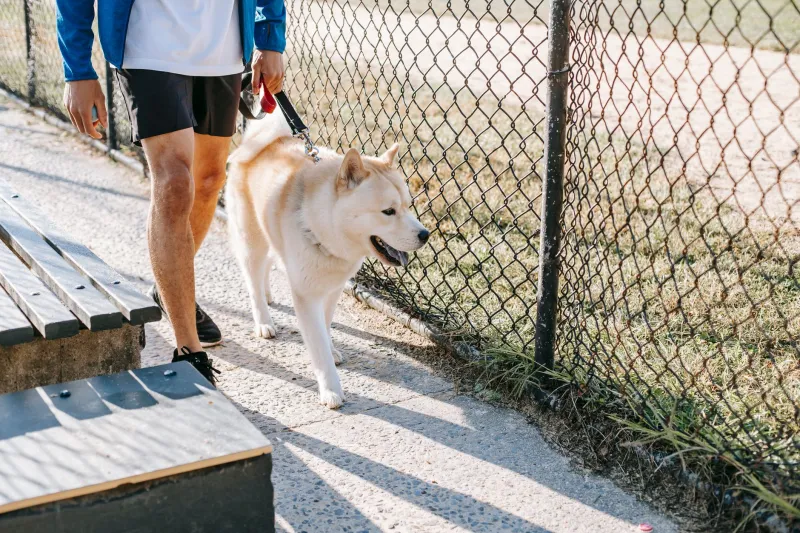
Walk the detour once without your dog if you can, so you know where the fencing actually goes and where the sidewalk returns. Keep the leash shorter near equipment and never assume a driver can see you — backup alarms are loud for a reason, and operators have blind spots the size of a small car. Take the quiet side of the street. Avoid the loose gravel and the areas where water pools around the site fencing.
If your dog is struggling, shorten the walk rather than pushing through it. A ten-minute sniff around a quiet block is worth more than a battle past the loudest corner. And remember that construction zones generate food trash, which means more scavenging risk than usual — keep to the inside of the sidewalk and watch the ground.
The lost-pet math of a construction zone
Gates get left open. Fencing shifts. Crews come and go, and a startled dog bolting through an unlatched gate in a zone full of trucks is a genuinely dangerous situation.
Check that the collar tag is readable and riveted on, not dangling by a thread. Confirm the microchip registration has your current phone number — a chip that points to a disconnected line is a chip that does nothing. Take a clear, recent photo of your dog this week and keep it on your phone. If your dog is noise-sensitive, double-check the yard gate before letting them out during active work hours, and consider going out with them instead of sending them alone.
When to stop managing and call us
Coping strategies have limits, and there is no prize for toughing it out. Call us if your dog has not eaten for a full day, is having repeated bouts of vomiting or diarrhea, is panting heavily at rest indoors, has injured a paw, or is showing a level of anxiety that is not improving with management. Sudden noise aversion in an older pet can also be an early sign of pain or cognitive change, and that is worth a real exam rather than another white noise machine.
For some pets, short-term anti-anxiety medication during a demolition phase is the humane, sensible choice. It is not a failure of training. It is the same logic as taking an aspirin for a headache.
The harbor is going to keep changing. Your dog does not have to white-knuckle their way through it.